
Choosing the Right Multifamily Market in Northern Virginia
Choosing the Right Multifamily Market in Northern Virginia
When it comes to market-selection-noVA, market selection in Northern Virginia demands disciplined fundamentals review: vacancy rates are edging up regionally as rent growth cools sharply, even as the submarket continues outperforming the broader DC area. Value Investment Partners, based in Sterling, VA, targets submarkets showing resilient occupancy despite this cooling trend.
Market selection in Northern Virginia hinges on submarket performance data, since the region consistently outperforms the broader Washington, D.C. metro despite cooling rent growth and rising vacancy rates. Value Investment Partners evaluates these multifamily fundamentals for accredited investors, identifying recession-resistant submarkets poised for stable occupancy and long-term passive returns through institutional-quality apartment syndications.
Key Takeaways
- Northern Virginia's multifamily market outperforms the Washington, D.C., region with stronger fundamentals and occupancy rates.
- Vacancy rates are edging upward across the region as rental growth cools sharply from previous years.
- Richmond metro achieved 95.7% occupancy in Q2 2026, demonstrating tight market conditions despite modest year-over-year decline.
- Single-family rentals now house 41% of the U.S. renter population, reshaping multifamily investment strategies nationwide.
Why Does Market Selection Matter in NoVA?
Market selection determines whether a passive investor's capital lands in a submarket still climbing or one quietly cooling. Market selection separates recession-resistant returns from guesswork, especially across a region as varied as Northern Virginia. Skip this step, and limited partners risk capital sitting in a softening pocket while better-performing counties outpace it.
Northern Virginia continues to lead the greater Washington, D.C. region in multifamily performance, though conditions are growing more complex, Northern Virginia's multifamily market outperforms. DC shows surprising rebound reported on Aug. 4, 2025. Vacancy rates are edging up across the region at the same time. Rent growth, meanwhile, is cooling sharply compared to prior years. That combination matters: a market can still "lead" its peers while softening underneath, and overlooking that nuance costs investors real yield.
Is Virginia's Multifamily Market Still Growing?
Growth continues, but at a slower pace. The Q2 2025 Virginia Multifamily Market Report found positive absorption in the second quarter, though it slowed from a year earlier and the statewide vacancy rate inched down. Steady, not explosive, is the current picture.
What Separates Strong Submarkets From Weak Ones?
Not every county inside Northern Virginia performs identically. How markets get selected across Northern Virginia hinges on tracking:
- Vacancy trends by submarket, not just regional averages
- Rent growth momentum versus the prior year
- Absorption pace relative to new deliveries
Disciplined underwriting of these factors is what separates high-growth multifamily markets in Northern Virginia from submarkets coasting on past momentum. Skilled market selection is the first safeguard protecting a limited partner's capital before a single property gets underwritten.

How Do We Select NoVA Markets?
Market selection for Northern Virginia starts with supply discipline, not hype. Virginia's multifamily construction has slowed sharply, with new deliveries running at roughly half the pace recorded a year earlier, according to the Q2 2025 Virginia Multifamily Market Report. Fewer new units entering a market mean less competition for existing apartment communities. That dynamic protects occupancy and pricing power for owners already in place.
Value Investment Partners treats this kind of supply data as a filter before anything else. The firm's market-selection-noVA process weighs construction pipelines against population. Job growth, screening out submarkets where overbuilding threatens future rent performance. Rent trends confirm the opportunity: levels continue climbing across every metro market in the Commonwealth, a clear signal of tenant demand outpacing new supply.
Delivery slowdowns play out differently by submarket. The Richmond metro area, for instance, saw a steep drop in new units completed during the second quarter, illustrating how supply constraints shift from one Virginia market to the next. This variation is exactly why how we select northern Virginia markets requires submarket-level analysis, not a single regional snapshot.
What makes a submarket a high-growth opportunity? A submarket qualifies as one of the high-growth multifamily markets noVA investors should watch when rent growth stays positive while new construction pulls back. That combination signals pricing power without the risk of oversupply eroding returns. Investors benefit most when demand indicators and limited deliveries move together.
How selective is the screening process? Very selective. Value Investment Partners evaluates a wide range of commercial real estate opportunities at any given time. Only a small fraction meet the firm's stringent investment criteria. This disciplined screening protects limited partners from markets where fundamentals look attractive on the surface but carry hidden supply risk underneath.
What Makes NoVA High-Growth Multifamily Markets?
Growth in Northern Virginia multifamily properties traces back to three forces: shifting renter demand, tight occupancy, and expanding capital for rental housing. None of these forces is speculative. Each shows up in national and regional data that Value Investment Partners tracks closely when evaluating opportunities for its limited partners.
Renter preferences nationwide have moved decisively toward rental housing. renter population, according to Rentometer's Mid-Year Report 2025, a shift that reshapes how investors evaluate rental housing stock across growing metro areas, including Northern Virginia. That demand pattern anchors market selection in Northern Virginia. Value Investment Partners prioritizes submarkets where renter demand consistently outpaces new supply.
What role does capital financing play in Northern Virginia's rental growth?
Capital keeps flowing into rental housing nationally, not just into one property type. An $802 million build-to-rent collateralized loan obligation closed in 2025, a signal that lenders view rental housing financing with real confidence. That financing activity feeds the broader pipeline of rental communities competing for the same renters active in Northern Virginia submarkets.
Fundamentals held firm through the first half of 2026, supported by high occupancy, positive rent growth, and an elevated construction pipeline nationally. Virginia's apartment submarkets mirrored that strength: occupancy climbed 40 basis points quarter-over-quarter to reach 95.7%, according to the Mid-Atlantic Multifamily Real Estate Market Reports.
How does Value Investment Partners identify high-growth multifamily markets across Northern Virginia?
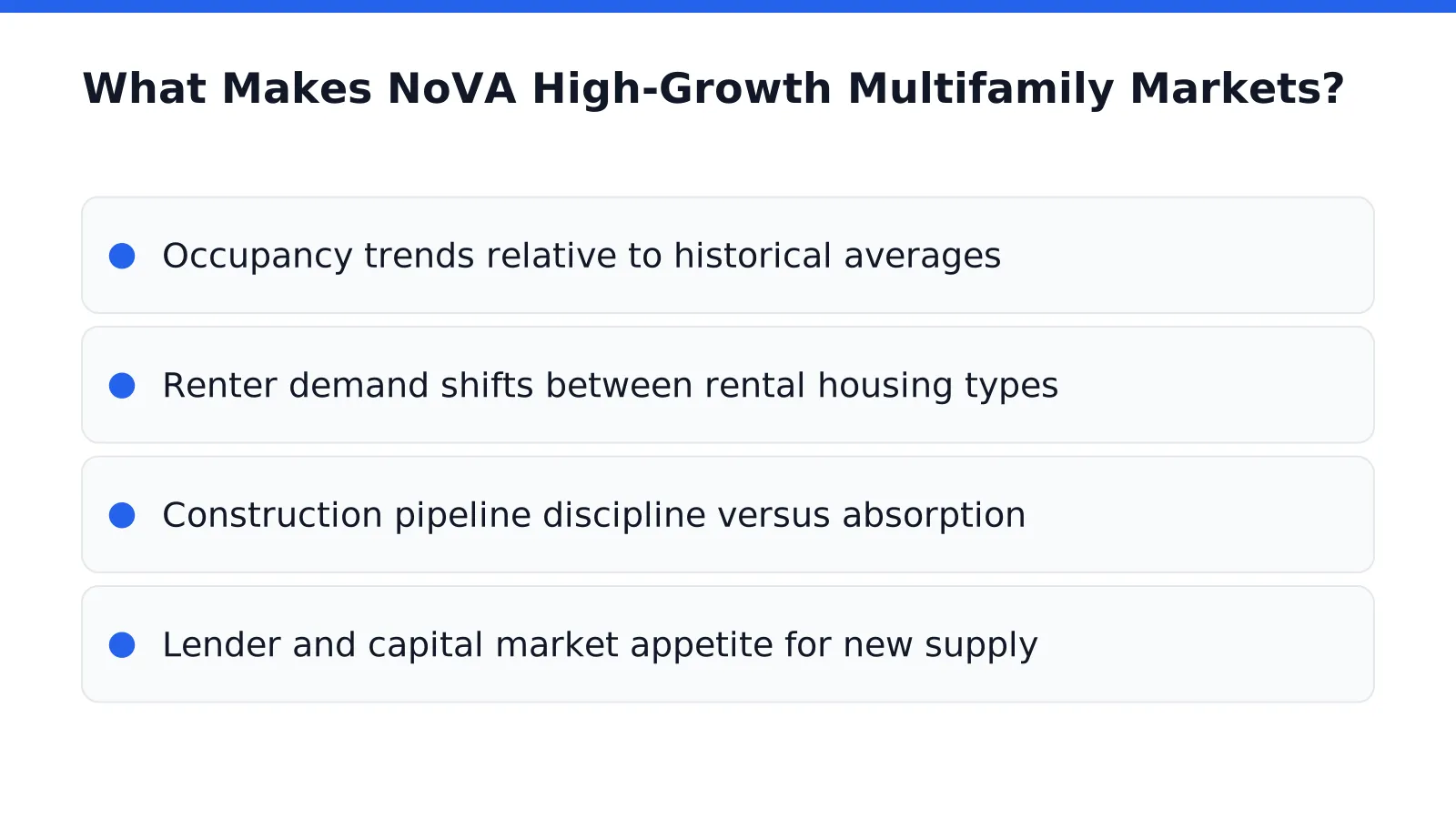
The process for selecting Northern Virginia markets weighs several data points together rather than any single metric:
- Occupancy trends relative to historical averages
- Renter demand shifts between rental housing types
- Construction pipeline discipline versus absorption
- Lender and capital market appetite for new supply
Taken together, these indicators define high-growth multifamily markets across Northern Virginia, the kind of submarkets accredited investors look for when building recession-resistant portfolios.

Why Watch Vacancy and Rent Trends in NoVA?
Vacancy and rent trends reveal how much pricing power a property owner actually holds. Rising vacancy with cooling rent growth signals a market shifting toward tenants. Stable vacancy alongside steady rent gains points to continued landlord leverage. For limited partners evaluating multifamily syndications, these two metrics separate markets with real staying power from markets riding temporary momentum.
Northern Virginia's multifamily sector has outperformed the broader Washington, D.C. region even as the capital shows a surprising rebound of its own. That contrast matters. A submarket that holds its edge against a recovering neighbor demonstrates durable underlying demand, not just short-term luck.
Is rent growth slowing in the Virginia multifamily market?
Growth is moderating, not disappearing. Average effective rental rates in the broader Virginia multifamily market rose 1.4% year-over-year, confirming that landlords still hold pricing power even in a cooling cycle. Absorption, however, fell roughly 55.3% year-over-year in part of that market, a clear sign that lease-up pace has slowed. Investors should read these two figures together rather than separately.
Does slower absorption mean investor demand is fading?
Not at all. Multifamily sales volume through the first half of 2026 significantly outpaced the same period in each of the prior three years. Even topped full-year totals from 2023 and 2024. That combination, cooling absorption alongside rising transaction volume, tells a specific story:
- Investors are still buying aggressively despite slower lease-up.
- Capital is targeting markets expected to tighten again once deliveries slow.
- Pricing discipline matters more than chasing peak-cycle growth rates.
This is precisely the data market-selection-noVA decisions should rest on, not headlines alone.
Ready to Invest in NoVA Multifamily Deals?
Participation starts with meeting accredited investor requirements; contact the brand directly for specific qualification details.
Investors who meet these thresholds gain access to opportunities built around disciplined market selection in Northern Virginia. Each deal reflects the same process: evaluating submarket fundamentals, employment drivers, and rent trends before capital ever moves.
How does Value Investment Partners choose which properties to present?
Value Investment Partners relies on a structured review process grounded in how it selects Northern Virginia markets. Qualifying opportunities get presented to partners through a dedicated Investor Portal, where supporting details help each investor evaluate suitability before committing.
What happens after an investor expresses interest?
A 1:1 phone call comes next. This conversation covers personal financial goals, investment criteria, and questions about the strategy behind targeting high-growth multifamily markets in Northern Virginia.
The path forward is straightforward:
- Confirm accredited investor status
- Review opportunities through the Investor Portal
- Schedule a personal consultation call
- Join Club "VIP" to participate in upcoming offerings
Each step builds confidence before any commitment is made.
FAQ
Why does market selection matter in Northern Virginia's multifamily sector?
Market selection determines whether capital lands in a submarket still climbing or one quietly cooling. It separates recession-resistant returns from guesswork across a region as varied as Northern Virginia.
Is Virginia's multifamily market still growing?
Growth continues, but at a slower pace, with positive absorption in Q2 2025 that slowed from a year earlier while the statewide vacancy rate inched down. The picture is steady rather than explosive.
What factors separate strong NoVA submarkets from weak ones?
Strong submarkets are identified by tracking vacancy trends by submarket rather than regional averages, rent growth momentum versus the prior year, and absorption pace relative to new deliveries. Value Investment Partners, based in Sterling, VA, applies this disciplined underwriting to protect limited partners' capital.
Conclusion
In closing, selecting the right multifamily market in Northern Virginia requires balancing growth potential with fundamental investment principles, understanding local demographics, employment drivers, and supply dynamics shapes confident decision-making. The region's strong fundamentals create genuine opportunities for investors willing to conduct thorough analysis and think long-term. Your success depends not on chasing trends. On building a clear framework for evaluating where institutional-quality apartment investments align with your wealth-building goals.


