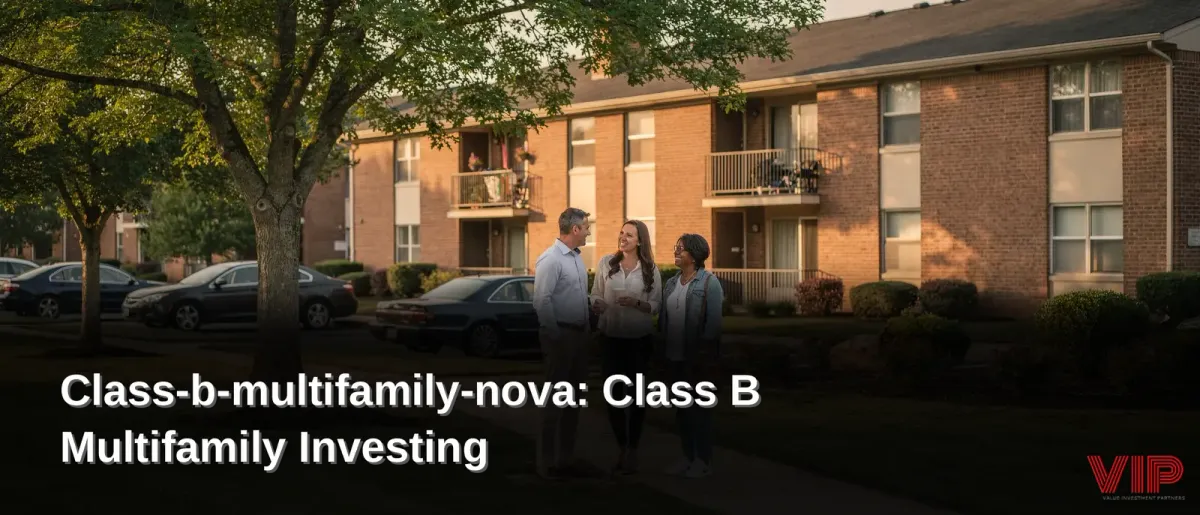
Class-b-multifamily-nova: Class B Multifamily Investing in Northern
Class-b-multifamily-nova: Class B Multifamily Investing in Northern
By Value Investment Partners Editorial Team · Updated 2026-09-05
Class B multifamily properties in Northern Virginia may provide opportunities for stable cash flow through value-add apartment communities near strong employment corridors like Arlington and Fairfax County. Value Investment Partners structures these syndications for passive ownership, removing landlord duties while targeting long-term appreciation. Club VIP members schedule a 1:1 call to review current opportunities and investment criteria.
Key Takeaways
- Class B multifamily properties in Northern Virginia generate higher rental income than single-family rentals through multiple units.
- Northern Virginia's strong employment corridors drive consistent tenant demand and long-term property appreciation for multifamily investors.
- Multifamily investments combine rental cash flow, housing flexibility, and wealth-building potential across Arlington, Fairfax County, and surrounding markets.
- Multifamily properties offer superior returns compared to residential rentals by consolidating 5+ units into single income-producing assets.
What Are Class B Apartments in Northern Virginia?
Class B multifamily properties in Northern Virginia describe apartment communities that fall between top-tier new construction and older, budget-tier housing. Investors, lenders, and brokers rely on property classifications like Class A, B, and C to communicate quickly about a building's age, condition, and quality. Without this shorthand, evaluating a deal in Arlington, Fairfax County, or Prince William County would require far more guesswork.
Each letter grade signals something specific about risk and return. A Class A property typically commands premium rents but offers thinner margins for improvement. A Class C property carries more deferred maintenance and tenant turnover risk. Class B sits in the middle, often built one or two decades ago, well-maintained, and priced to attract renters who want quality without paying top-of-market rates.
What separates Class B from Class A and Class C?
The gap comes down to age, finishes, and rent-growth potential. Class A buildings feature newer construction and higher-end amenities; Class C buildings are older with limited upgrades. Class B properties offer solid bones and room for renovation, which is exactly why investing in Class B properties across Northern Virginia appeals to investors chasing value-add returns.
Does Class B apply to any rental property?
No. This classification system applies to commercial multifamily real estate, not to one-to-four unit residential rentals like single-family homes or townhouses. Those smaller properties get classified for lending purposes the same way single-family homes do, placing them in a separate category entirely.
Commercial real estate itself is not a single market. It spans distinct asset classes, each with its own buyer pool, return profile, and risk story. Understanding what qualifies as a Class B apartment in Northern Virginia helps accredited investors match their capital to the risk-and-return profile that fits their goals, without ever picking up a maintenance call themselves.

Why Is Northern Virginia Prime for Class B?
Employment strength makes Northern Virginia one of the most reliable regions for class-b-multifamily-noVA investing. Rental income, long-term appreciation, and proximity to one of the strongest employment corridors in the country combine to give this asset class staying power that few markets can match. Job growth alone does not explain the opportunity, though; geography and daily commuter demand play an equally large role.
Northern Virginia is not one market. A patchwork of distinct submarkets, each with its own tenant profile and rent dynamics. Arlington offers properties positioned near Metro corridors, drawing renters who prioritize a short commute. Fairfax County contributes established suburban neighborhoods with deep rental histories. Prince William County and Stafford County round out the picture with more accessible entry points for investors exploring this space for the first time.
What makes Class B apartments attractive in Northern Virginia specifically?
Northern Virginia has never functioned as a static real estate market. It moves with the constant rhythm of commuting and employment activity across the region. That movement keeps rental demand steady, even during broader economic slowdowns. Investing-in-class-b-noVA properties benefits directly from this pattern, since renters need housing near job centers regardless of market cycles.
How should investors evaluate which submarket fits their goals?
Choosing a submarket starts with understanding what-are-class-b-apartments-noVA actually offer compared to other commercial asset classes. Commercial real estate spans several distinct categories, each with its own buyer pool, lease structure, and risk profile. Recognizing which class aligns with an investor's goals marks the first real step toward a sound decision in Northern Virginia real estate.
- Arlington: transit-oriented demand near Metro corridors
- Fairfax County: established suburban rental base
- Prince William County: growing investment activity
- Stafford County: accessible entry-level rental opportunities
Value Investment Partners serves Northern Virginia investors seeking this exposure without hands-on landlord duties.

How Does Class B Compare to Single-Family Rentals?
Cash flow tells the story. A Class B multifamily property in Northern Virginia holds multiple rental units under one roof, giving it the potential to generate higher combined rental income than a single-family home ever could from one tenant. That structural difference shapes nearly everything else about risk and return for accredited investors weighing both paths.
Single-family rentals across Northern Virginia's suburbs depend entirely on one tenant. When that tenant moves out, income stops completely until a replacement signs a lease. A duplex or garden-style apartment building spreads that risk across several units instead of concentrating it in one household.
Why does vacancy hurt single-family investors more?
Vacancy in a single-family rental means zero income until the home is re-leased. In a Class B building, one empty unit gets offset by rent from occupied units, keeping cash flow steadier and more predictable.
Are Class B apartments financed differently than small rentals?
Yes. Lenders classify 1-4 unit residential rentals, including the single-family homes and townhouses common throughout Northern Virginia, in a separate category from larger commercial multifamily assets. Investing in Class B properties throughout the region means stepping into commercial-grade underwriting, not the residential mortgage process homeowners use.
For investors exploring what Class B apartments actually offer, the comparison comes down to stability. Multiple income streams under one roof cushion against the vacancy swings that single-family landlords absorb alone.

What Risks and Rewards Come With Class B?
Class B multifamily properties balance risk. Reward differently than newer Class A towers or aging Class C buildings, often requiring renovation. RealtyMogul.com explains that each property class represents a different level of risk. Return, a distinction that matters directly to accredited investors weighing class-b-multifamily-noVA opportunities against their personal financial goals. Northern Virginia's Class B stock, often found in established suburban corridors near Fairfax County and Prince William County employment centers, tends to offer steadier cash flow with less exposure to the leasing risk that hits newer, amenity-heavy developments.
The reward side centers on value. Class B buildings typically carry lower acquisition costs than Class A properties, while still drawing dependable renter demand from Northern Virginia's deep employment base. The risk side involves aging systems, dated interiors, and the capital investment often required to reposition a property for stronger rents.
Investing in Class B NoVA properties means accepting a different buyer pool and lease structure than other commercial asset classes carry. Every segment of commercial real estate, whether office, retail, or multifamily, has its own return profile and risk story, and Class B apartments fit a middle-ground niche between stability and upside.
Why do investors and lenders classify properties at all?
Classifications exist so investors, lenders, and brokers can communicate a building's quality quickly, without inspecting every unit individually. This shorthand helps accredited investors screen opportunities faster before committing capital.
Is Class B riskier than Class A?
Not necessarily. Class B carries different risks, tied more to renovation needs than to tenant vacancy. Class A properties often depend on premium rents holding steady in competitive Northern Virginia submarkets.
How Can You Invest in Class B Passively?
Passive access to class-b-multifamily-noVA properties starts with a syndication partner rather than a solo purchase. Value Investment Partners, based in Sterling, VA, works with accredited investors pursuing multifamily opportunities across markets including Northern Virginia's established suburban corridors. Skipping the tenant calls, maintenance emergencies, and financing headaches, investors instead hold an ownership stake alongside a team managing the asset day to day.
The firm operates as a two-person team, which shapes the client experience directly. Onboarding feels personal rather than transactional. Conversations happen with the people actually running the investment strategy, not a rotating call-center staff. For someone new to investing-in-class-b-noVA properties, that direct line matters — questions get answered by decision-makers, not scripts.
What does the onboarding process look like?
Interested investors typically start with a 1:1 call to discuss personal goals and investment criteria. Sophisticated and accredited investors exploring what-are-class-b-apartments-noVA opportunities can use this conversation to understand upcoming deals, timelines, and how a given property fits their portfolio. No pressure, no scripted pitch — just a direct conversation about fit.
That relationship is formalized through Club VIP, the firm's membership structure for investors who want ongoing access to Northern Virginia multifamily opportunities as they arise.
Trust matters here, especially with capital committed for years. Investors weighing a firm's credibility should consider a few markers:
- Accreditation with the Better Business Bureau, reflecting ethical business practices
- Direct access to the team managing the investment
- Transparent onboarding built around a personal conversation, not a sales funnel
Building confidence in a passive structure takes time, but starting with a real conversation makes the next step clearer.
FAQ
What defines a Class B multifamily property in Northern Virginia?
Class B properties sit between premium new construction and older budget housing, typically built one or two decades ago, well-maintained, and priced to attract quality-seeking renters without top-of-market rents.
Why does Northern Virginia suit Class B multifamily investing?
Employment strength near corridors like Arlington. Fairfax County drives consistent tenant demand, supporting rental income and long-term property appreciation for multifamily investors in the region.
How does Value Investment Partners help investors access these deals?
Value Investment Partners, based in Sterling, VA, structures syndications for passive ownership, removing landlord duties while targeting long-term appreciation for accredited investors.
Conclusion
In closing, Class B multifamily properties in Northern Virginia represent a thoughtful path toward building wealth through real estate without the burden of active management. By understanding market fundamentals, evaluating property quality, and recognizing the region's economic strengths, you position yourself to make informed investment decisions aligned with your financial goals. The knowledge you've gained here forms a foundation for evaluating opportunities that match your investment timeline and risk tolerance.


