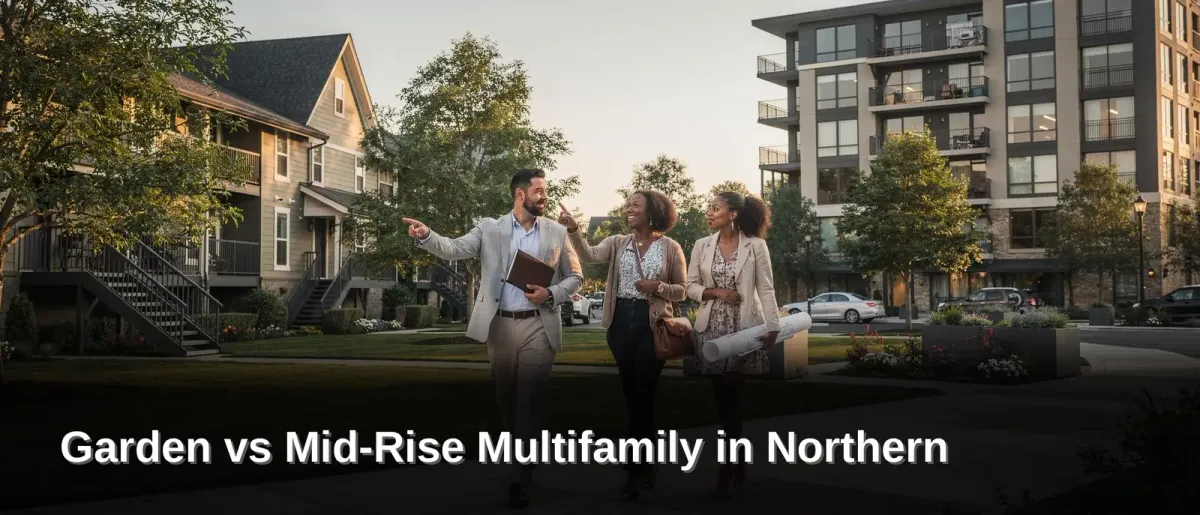
Garden vs Mid-Rise Multifamily in Northern Virginia
Garden vs Mid-Rise Multifamily in Northern Virginia
Garden-style multifamily in Northern Virginia delivers lower construction costs near $130–190 per square foot, wider cap rates, and simpler value-add renovations. Mid-rise wrap and podium properties run $200–275 PSF, offering higher density, stronger infill rent ceilings, and distinct NOI margins that shape syndication structures
Key Takeaways
- Density tier selection determines construction type, parking ratios, rent ceilings, NOI margins, and capital sources simultaneously.
- Garden wood-frame construction costs $130–190 PSF in 2026; mid-rise runs $200–275 PSF.
- Garden-style apartments dominate suburban markets while high-rise buildings concentrate in major urban centers.
- Multifamily housing remains stable across shifting markets due to consistent renter demand in Northern Virginia.
What Separates Garden From Mid-Rise Multifamily?
Density tier decides almost everything else in a multifamily deal. Picking garden-vs-mid-rise-noVA as the first question locks an investor into a construction type, a cost-per-square-foot range, a parking ratio, a rent ceiling, and eventually an exit cap rate. These are the exact criteria Value Investment Partners uses when screening Northern Virginia acquisitions for Club "VIP" members.
Two properties sitting on the same stretch of road in Northern Virginia can look nearly identical from a car window. One might be a wood-frame garden community with surface lots; the other a steel-and-podium mid-rise with structured parking underneath. The difference shows up in operating complexity, financing terms, and resident expectations, not in the facade.
What drives the cost and rent differences between garden and mid-rise?
Garden-apartments-northern-virginia projects generally use lighter wood-frame construction, which keeps costs lower but caps unit density and rent ceilings. Mid-rise-apartment-investing-noVA opportunities carry higher per-square-foot construction costs tied to steel or podium framing, yet they support denser unit counts and stronger urban-infill rents.
Why does national supply data matter for Northern Virginia investors?
Garden-style product still dominates the national construction pipeline, with mid-rise forming a meaningful second tier. That mix matters because it shapes the competing supply any Northern Virginia acquisition will lease against. It influences the cap rates investors can expect at exit.
How Do Garden Apartments Perform In Northern Virginia?
Garden apartments perform well as steady, lower-cost income producers across Northern Virginia's suburban corridors. These communities deliver dependable cash flow by keeping construction and operating costs below taller alternatives, while still meeting the housing demand that defines the region's outer counties. For passive investors weighing garden-vs-mid-rise-noVA decisions, the layout itself tells most of the performance story.
Garden-apartments-northern-virginia communities are typically low-rise, often one to four stories, arranged around landscaped grounds with exterior unit entrances and surface parking lots. This design is common throughout Northern Virginia's suburban belt, where land is available and height restrictions often favor horizontal rather than vertical construction. Garden-style and townhome properties also tend to blend into the surrounding single-family neighborhoods, making them a natural fit for the outer suburbs rather than dense urban cores.
Why Does The Garden Layout Matter For Investors?
The layout shapes resident experience and, by extension, occupancy stability. Easier parking access and outdoor space can be real advantages. Safety and convenience still hinge on how well a property manages entrances, visitors, lighting, and deliveries. Well-managed garden assets tend to retain tenants longer, supporting consistent rental income.
What Does Garden Construction Mean For Costs?
Garden product relies on wood-frame construction, which keeps per-square-foot building costs on the lower end of the multifamily spectrum. That cost advantage over mid-rise and high-rise alternatives translates into a more accessible entry point for value-add strategies. Value Investment Partners evaluates these cost dynamics closely when sourcing Northern Virginia opportunities for Club "VIP" members. Lower basis per unit often supports stronger margin potential once renovations are complete.
What Does Mid-Rise Investing Look Like In NoVA?
Mid-rise properties sit between low-rise garden communities and downtown towers. Typically four to eight stories, built with wrap or podium construction over a parking deck, these assets target growing town centers rather than dense urban cores. High-rise construction stays reserved mainly for areas where horizontal space runs out, which explains why mid-rise fills the gap in Northern Virginia's expanding employment corridors.
Capital behaves differently at each density tier. Each tier, including mid-rise wrap and podium construction, targets a different cap rate and a different type of limited partner capital. Garden apartments in Northern Virginia typically attract investors chasing cash flow stability. Mid-rise assets often draw partners comfortable with added construction complexity in exchange for infill location and stronger rent growth potential.
Is mid-rise apartment investing in Northern Virginia riskier than garden-style?
Not inherently riskier, just structured differently. Mid-rise apartment investing in Northern Virginia carries higher construction costs per square foot than garden product. It positions capital closer to transit lines and job centers.
Why does renter demand matter for mid-rise underwriting?
Renter demand has stayed steady across many markets even as broader conditions shift. That stability supports mid-rise rent assumptions in Northern Virginia's employment-driven rental base, where residents often prioritize proximity over square footage.
Comparing garden-style and mid-rise properties in Northern Virginia comes down to a few decision points:
- Construction type and cost per square foot
- Target cap rate and anticipated exit pricing
- Limited partner risk tolerance
- Submarket density and commute patterns
Operators and investors planning ahead are revisiting these fundamentals before committing capital. It's a discipline Value Investment Partners applies when screening opportunities for Club "VIP" members, matching density tier to each partner's goals rather than forcing one strategy across every deal.
Which Asset Type Fits Your Investment Goals?
Goals determine the right asset type far more than personal taste does. A client chasing steady, lower-volatility income often leans toward garden product. One seeking stronger upside through renovation leans toward mid-rise. Value Investment Partners frames this decision around three factors: construction complexity, submarket positioning, and the capital improvement plan built into underwriting.
Garden apartments in Northern Virginia typically stay low-rise, often one to four stories, with landscaped grounds, exterior unit entrances, and surface parking. That simpler construction profile keeps renovation timelines shorter and capital expenditure budgets more predictable for passive partners. Mid-rise podium buildings, by contrast, involve denser construction and often sit closer to Northern Virginia's employment corridors, supporting different rent dynamics.
Is Garden-Style the Same as a Garden-Level Unit?
No. Garden style describes the layout of the entire property, not one apartment. Garden level refers to a specific unit positioned at or partly below ground level within a garden-style, mid-rise, or even high-rise building. Reviewing a Northern Virginia offering means checking both terms separately before assuming what's being described.
Why Don't High-Rises Dominate Northern Virginia Portfolios?
High-rise towers concentrate mostly in large cities, where land scarcity justifies the added construction cost. Northern Virginia's suburban and secondary-urban submarkets favor garden and mid-rise product instead, which blend more naturally into surrounding communities.
Mid-rise apartment investing in Northern Virginia suits clients comfortable with renovation timelines, while garden assets suit those prioritizing operational simplicity within a stable multifamily sector overall.
Which Multifamily Asset Type Should You Choose?
Garden-style communities and mid-rise properties serve different investor goals. The right pick depends on risk tolerance, cash flow timing, and appetite for value-add work. Value Investment Partners reviews both deal types across Northern Virginia, applying the same strict screening standards to each before presenting an opportunity to its partners. Few deals that cross the firm's desk actually clear that bar, whether the asset sits on a wooded garden lot or rises five stories above a retail podium.
Is garden-style investing a better fit for first-time passive investors?
Many first-time limited partners gravitate toward garden apartments in Northern Virginia because the renovation scope tends to be more contained and the operating model simpler to understand. That simplicity doesn't mean lower standards. Value Investment Partners still applies its stringent review process before any garden-style deal reaches a partner's inbox.
Does mid-rise investing require more active oversight from the sponsor?
Mid-rise apartment investing in Northern Virginia often involves more moving parts, from elevators to shared mechanical systems, which raises the bar for sponsor experience. Value Investment Partners' lean two-person team keeps communication direct and personal, so partners get clear updates rather than layers of corporate reporting.
Deciding between garden versus mid-rise properties in Northern Virginia starts with a conversation, not a guess. Accredited and sophisticated investors can schedule a 1:1 call with the firm to walk through personal goals, timelines, and risk comfort before committing capital to either path.
FAQ
What is the main cost difference between garden and mid-rise multifamily?
Garden wood-frame construction costs $130–190 PSF in 2026. Mid-rise wrap and podium properties run $200–275 PSF due to steel or podium framing.
Which construction type supports higher rents and density?
Mid-rise-apartment-investing-noVA properties support denser unit counts and stronger urban-infill rents. Garden projects cap unit density and rent ceilings with lighter wood-frame construction.
Who evaluates these density tiers for Northern Virginia acquisitions?
Value Investment Partners, based in Sterling, VA, uses construction type, cost per square foot, parking ratio, rent ceiling, and exit cap rate to screen acquisitions for Club "VIP" members.
Conclusion
In closing, your choice between garden and mid-rise multifamily investments depends on your priorities: garden communities offer stability and straightforward operations. Mid-rise properties deliver higher density returns and urban positioning. Both structures serve accredited investors seeking passive real estate exposure without landlord responsibilities. Understanding these distinctions empowers you to align your investment strategy with your wealth-building goals and risk tolerance.


