
Northern Virginia Real Estate Investment Guide
Northern Virginia Real Estate Investment Guide
Multifamily syndication delivers strong risk-adjusted returns in Northern Virginia. home prices keep climbing while rents soften slightly, reshaping cap rate and cash flow math. Value Investment Partners guides accredited investors, those with pricing varies annual income or pricing varies million net worth, through passive apartment investments without landlord duties, building long-term wealth through disciplined acquisition strategy.
Key Takeaways
- Northern Virginia's government and tech sectors drive consistent rental demand for investment properties.
- Arlington, Fairfax, and Alexandria neighborhoods deliver strong appreciation and cash flow potential.
- Successful investors analyze cap rate, cash flow, and appreciation before purchasing property.
- Property management quality directly impacts returns and long-term investment performance outcomes.
Why Does Northern Virginia Real Estate Still Work?
Strong returns in Northern Virginia come down to math, not instinct. Success rests on calculable numbers, not a gut feeling about whether a property looks promising. Cap rate, cash flow, appreciation, and the quality of day-to-day operations determine whether a deal actually performs once the closing papers are signed.
Northern Virginia runs on its own version of that math. National investing guides rarely account for a market where home prices keep climbing while rents have softened slightly. That combination changes what a healthy return looks like here compared to the averages quoted elsewhere. A smart multifamily investment strategy for Northern Virginia accounts for that gap rather than ignoring it.
Four factors separate a deal that performs from one that merely looks good on paper:
- Cap rate: measures income against purchase price, a baseline for comparing properties.
- Cash flow: what remains after expenses, the actual return investors feel.
- Appreciation: long-term value growth, shaped by local demand pressure.
- Operations: how well the property is managed day to day, often the difference between a profitable asset and a draining one.
Does appreciation alone make Northern Virginia a safe bet?
Appreciation matters, but it tells only part of the story. Rising home values can mask weaker rent growth, which affects cash flow regardless of what the price chart shows.
Why do national investing benchmarks fall short here?
Generic guides assume rents and prices move together. Northern Virginia's market currently shows the opposite pattern, which is exactly why investing in Northern Virginia calls for localized numbers, not borrowed assumptions. A disciplined passive multifamily strategy for the DMV adjusts for that local reality from day one.

What Returns Should Investors Actually Expect?
Returns in Northern Virginia multifamily properties hinge on three forces: steady rental demand, disciplined property management, and the broader commercial cycle. No single number applies to every deal. Rental return figures circulating online serve as general education only. Actual performance shifts with financing terms, property taxes, and insurance costs on each asset.
Government employment, growing tech industries, and strong school districts drive consistent tenant demand across the region. That demand base gives apartment owners a cushion that many other markets lack. Family offices and accredited investors evaluating a multifamily-investment-strategy-noVA approach often point to this demand stability as the foundation for predictable cash flow.
Does Management Quality Actually Change the Return?
Yes, substantially. Professional, disciplined oversight of a property is directly tied to protecting the return that asset can deliver. Poor management erodes occupancy and raises turnover costs, even in a strong-demand market like Northern Virginia.
Is the Broader Market Still Favorable for New Capital?
Virginia's commercial real estate sector is moving through a period of dynamic growth, creating real opportunity for investors entering now. That momentum doesn't guarantee outsized returns, but it does widen the pool of viable acquisition targets.
For investors building a passive-multifamily-strategy-dmv, the practical takeaway looks like this:
- Demand side: government, tech, and education sectors anchor tenant pools across the region.
- Operations side: disciplined management protects margins and net returns.
- Market side: Virginia's commercial growth cycle continues to generate new acquisition opportunity.
Choosing to invest in noVA multifamily assets means weighing these three factors together, not relying on a single projected percentage. Returns reward investors who understand the local demand drivers and insist on professional management protecting their capital.
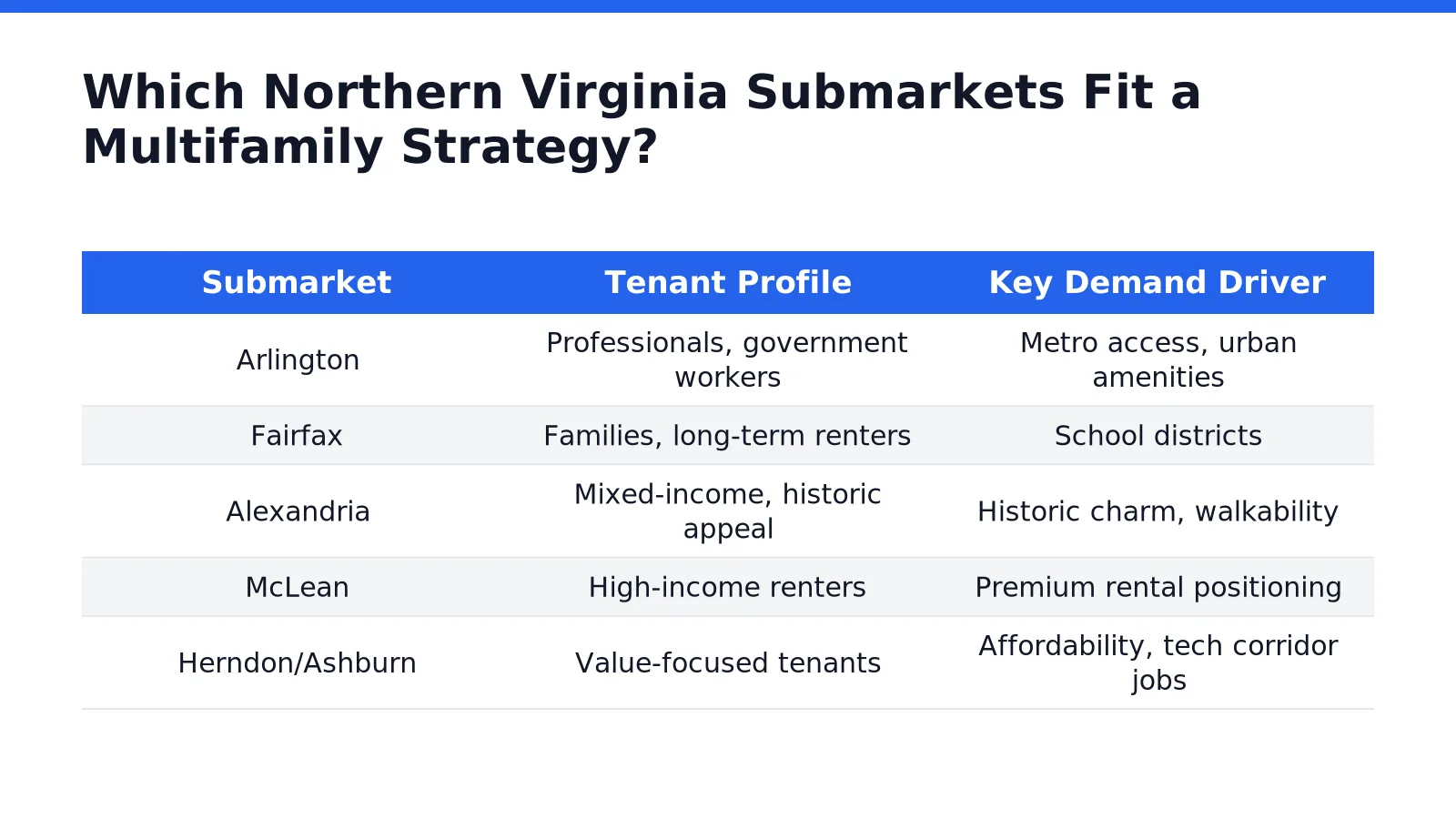
Which Northern Virginia Submarkets Fit a Multifamily Strategy?
Arlington, Fairfax, and Alexandria stand out as the strongest submarkets for long-term multifamily returns in Northern Virginia. Each location offers a distinct combination of tenant demand, income levels, and growth trajectory that shapes a sound multifamily-investment-strategy-noVA investors can rely on. Skipping this submarket analysis costs investors the ability to match risk tolerance with the right property type.
Submarket selection drives the entire approach to building an invest-in-noVA portfolio. McLean attracts higher-income renters willing to pay premium rates. Herndon and Ashburn offer more budget-conscious rental stock with steadier occupancy. Matching a property's tenant profile to the surrounding submarket reduces vacancy risk and keeps income predictable.
What makes one submarket stronger than another?
Strength comes down to what drives tenants to choose a neighborhood in the first place. Metro access pulls commuters toward Arlington, strong school districts anchor family demand in Fairfax, and historic charm sustains interest in Alexandria. These differentiators explain why no single submarket fits every investor's goals.
Does submarket growth reflect the broader Virginia market?
Growth patterns in Arlington mirror what's happening across the Commonwealth, where mixed-use development signals expanding commercial and residential activity. That broader momentum supports a passive-multifamily-strategy-dmv approach, since regional growth reduces single-neighborhood dependency. Investors benefit from exposure to a market expanding on multiple fronts rather than one isolated pocket.

How Does Passive Multifamily Investing Work in the DMV?
Passive multifamily investing in the DMV pools capital from several investors into one professional structure that purchases and manages an apartment property. This structure, known as an apartment syndication, exists to handle a large multifamily transaction that no single buyer could reasonably take on alone. A sponsor, often called the general partner, sources the deal, arranges financing, and runs the property day to day. Limited partners contribute capital and receive distributions without ever fielding a maintenance call.
Who Can Join a Multifamily Syndication?
Participation as a limited partner requires accredited investor status, a legal classification based on income or net worth. Current thresholds call for annual income of pricing varies for individuals, or pricing varies for joint filers, sustained over the past two years with a reasonable expectation of continuing at that level. Net worth above pricing varies million, individually or with a spouse, satisfies the requirement as well. Meeting one of these two paths qualifies an investor to pursue passive multifamily strategy dmv opportunities.
What Fees Should Investors Expect?
Acquisition fees compensate the general partner for finding, evaluating, financing, and closing the transaction. Larger acquisitions often land toward the lower end of that range. Smaller deals carry proportionally higher fees given the fixed work involved.
Value Investment Partners, based in Sterling, VA, structures opportunities for investors pursuing a multifamily investment strategy noVA residents and family offices can access without landlord duties. Serving clients across Northern Virginia and the broader DMV market, the firm applies this syndication model to help accredited investors invest in noVA multifamily assets confidently and with full clarity on fee structure.
What Should Accredited Investors Do Next?
Accredited investors ready to move forward should start by clarifying their goals and comparing them against a vetted deal pipeline. Northern Virginia's rental market rewards patience and local expertise. The next step matters more than the first idea that looks promising. Skipping proper vetting risks tying up capital in a deal that never matches a client's risk tolerance or timeline.
Value Investment Partners reviews numerous commercial real estate opportunities across the region but presents only those meeting strict investment criteria. That filtering process protects partners from deals that look appealing on paper but fall short on fundamentals like cash flow or market timing.
How Does Someone Get Access to VIP's Opportunities?
Interested accredited investors can schedule a one-on-one call to discuss personal goals and investment criteria directly. This conversation determines fit before any commitment is made. It's the clearest way to understand how a passive-multifamily-strategy-dmv approach might apply to an individual portfolio.
Once that relationship is established, next steps typically include:
- Joining Club "VIP" to gain access to upcoming opportunities
- Reviewing vetted deals shared through a dedicated investor portal as they become available
- Discussing how a multifamily-investment-strategy-noVA fits long-term wealth goals
Partnering with experienced, local property management support throughout the investment lifecycle also strengthens outcomes for anyone looking to invest-in-noVA without taking on landlord duties.
FAQ
What makes Northern Virginia real estate different from national markets?
Northern Virginia home prices keep climbing while rents soften slightly, reversing the typical pattern where prices and rents move together. This gap means investors need localized cap rate and cash flow math rather than borrowed national assumptions.
Who qualifies as an accredited investor for these deals?
Value Investment Partners works with accredited investors meeting SEC thresholds: pricing varies in annual income or pricing varies million in net worth. These investors gain passive apartment ownership without landlord duties.
What determines whether a multifamily deal actually performs?
Four factors drive performance: cap rate, cash flow after expenses, long-term appreciation, and day-to-day property management quality. Strong rental demand from government and tech employment supports these fundamentals across Northern Virginia.
Conclusion
In closing, building wealth through Northern Virginia real estate requires a thoughtful strategy that aligns with your financial goals and risk tolerance. By understanding the fundamentals of multifamily investing, evaluating market conditions, and recognizing the value of passive investment structures, you position yourself to make informed decisions that support long-term wealth accumulation. The path forward demands patience and education, but the opportunity to build institutional-quality real estate exposure without active management responsibilities remains within reach for accredited investors ready to take action.


